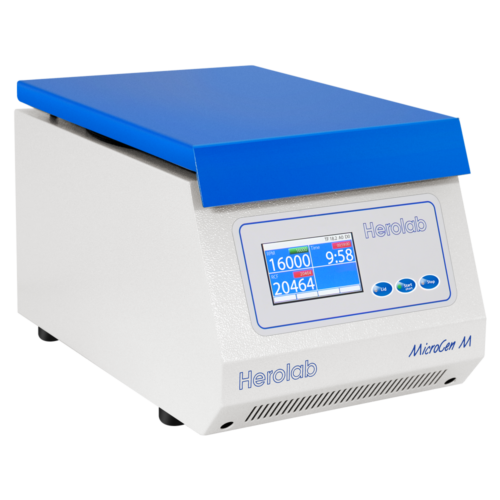
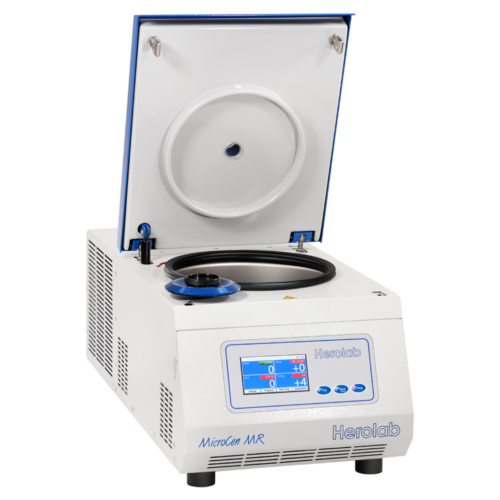
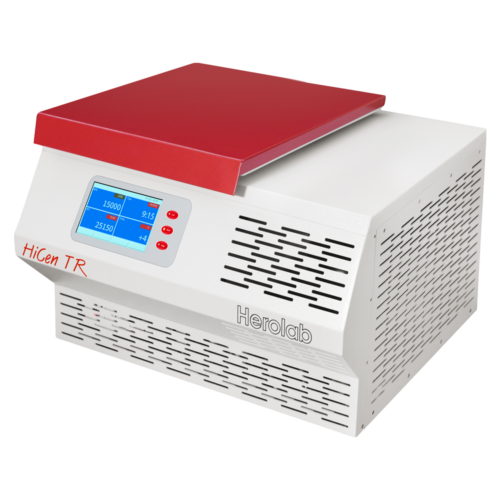
RobotCen for automated laboratory workflows
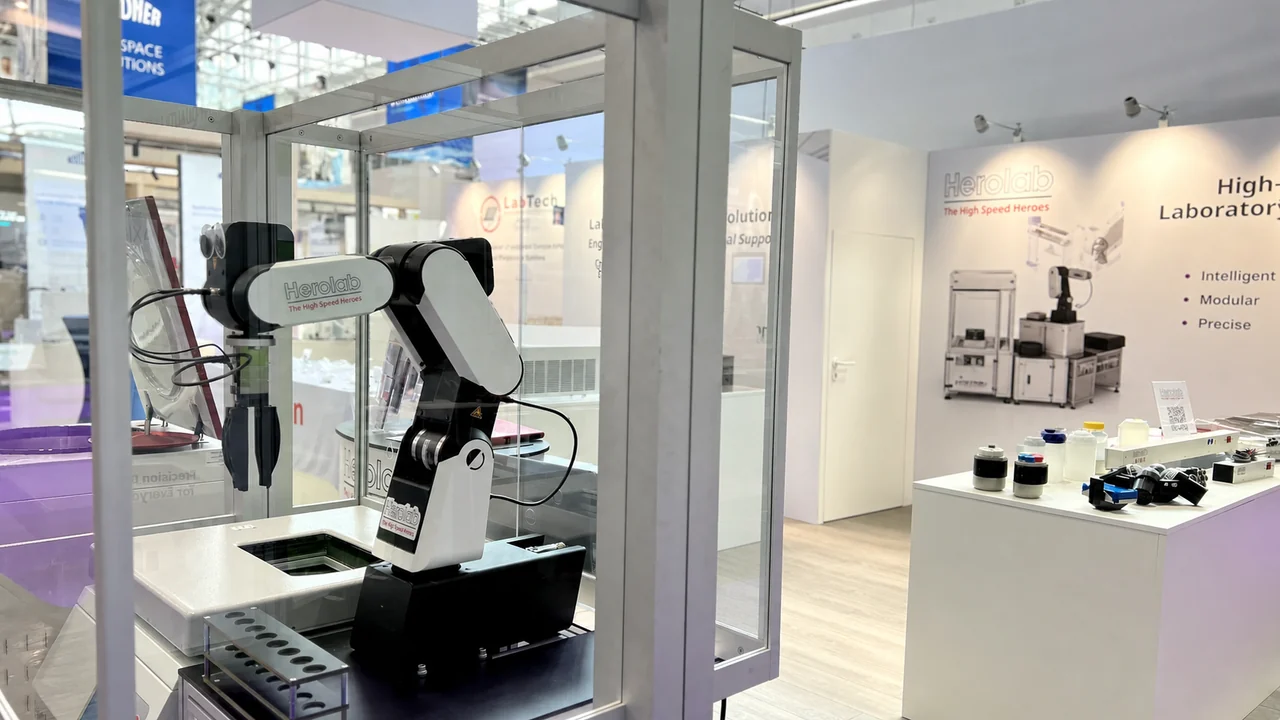
For recurring separation and purification steps, the laboratory centrifuge needs to fit the complete workflow. RobotCen combines centrifugation with coordinated sample transfer to the robot system. Rotor, vessels, gripper access and control requirements are considered together.
How centrifugation is integrated
- Position the rotor: The controller moves the rotor to the agreed position for sample handling.
- Load and unload: The external robot handles the vessels. Holders, gripping points, closures and access space need to be matched.
- Coordinate the sequence: Sample transfer, the centrifugation run and feedback signals are coordinated with the external controller. Actual throughput also depends on run time and handling.
Selecting the rotor, vessels and process
| Selection point | Configuration and details to confirm |
|---|---|
| Rotor type | Swing-out or fixed-angle rotor, selected for the laboratory centrifuge configuration and application. |
| Sample vessels | Bottles, tubes or microplates, depending on the rotor and holder. Specify dimensions, material, fill volume and closures. |
| Capacity | Capacity depends on the instrument, rotor and vessel. The FR reference configurations are shown below. |
| Speed and RCF | Defined for the specific rotor and vessel. Maximum values for the range do not apply to every configuration. |
| Cooling | A refrigerated version is available; confirm the temperature range and process conditions for the selected unit. |
| Communication | Serial communication; Herolab lists RS232/RS485 according to the agreed version. Protocol, commands, status and fault signals are specified for the project. |
Documented RobotCen FR configurations
The figures below are from the FR data sheet and support project assessment. The version available to order and its operating limits are confirmed for the specific project.
| Vessels | Rotor and accessories | Reference limits |
|---|---|---|
| 4 × 500 mL bottles | AS 4.500 (20 90 501 + 20 90 502) | 4,800 rpm · 4,508 × g |
| 6 × 250 mL vessels | AF 6.250 (20 22 100) | 8,000 rpm · 10,375 × g |
| up to 16 microplates | AS 4.500 (20 90 501 + 20 90 540) | 4,000 rpm · 2,719 × g |
| 8 × 50 mL Falcon tubes | AF 8.50.3 (20 98 105) | 13,500 rpm · 21,191 × g |
For 16 microplates, the AS 4.500 uses microplate carrier set 20 90 540. Round buckets 20 90 502 belong to the separate 500 mL configuration. The data sheet specifies 220–240 V, single phase, 50 Hz for FR reference 21 13 660.
The RobotCen range lists larger project configurations up to 6 × 1,000 mL. We assess the laboratory centrifuge, rotor and vessel combination against your project requirements. Labsun China overview
Installation and integration scope
Planning requires the dimensional drawing, weight, power supply, installation footprint and loading and maintenance clearances for the chosen version. Allow for the robot’s working envelope and vessel transfer path.
Before configuration approval, agree on interlocks, status signals, fault responses, protective measures and responsibility for acceptance of the complete system. Robot arm, gripper, supervisory software and integration services need to be specified separately in the project scope.
The quotation records responsibilities for equipment, controls, integration and acceptance. Acceptance criteria can cover representative vessels, repeatable transfer, the agreed cycle time and fault response. Labsun laboratory automation and system integration
Published application example: MINERVA
The 2025 paper by Zaki, Prinz and Ruehle describes MINERVA, a platform for synthesising and purifying nano- and advanced materials. Its “Purification” section identifies RobotCen with an AF 8.50.3 rotor for 8 × 50 mL. This is a documented research configuration; suitability for your process is assessed separately.
Read the study (PDF, English) · DOI: 10.1021/acsnano.4c17504
Product documentation
Download the RobotCen product catalogue (PDF, English, 4 pages)
The catalogue provides a product overview. For selection, please request the current configuration table, technical data, installation drawing and interface documentation for the proposed version.
What helps us assess your enquiry?
- Process and sample; vessel type, dimensions, fill volume and closure
- Samples per batch and required throughput
- Target RCF or speed, run time and temperature
- Robot platform, gripper, controller and available interfaces
- Space constraints and required supply and integration scope
You do not need to know every technical detail yet. A brief description of your workflow is enough to start the discussion. Please mention “RobotCen” in your message.
See Ordering Information for bottle, microplate and large-volume project enquiries.