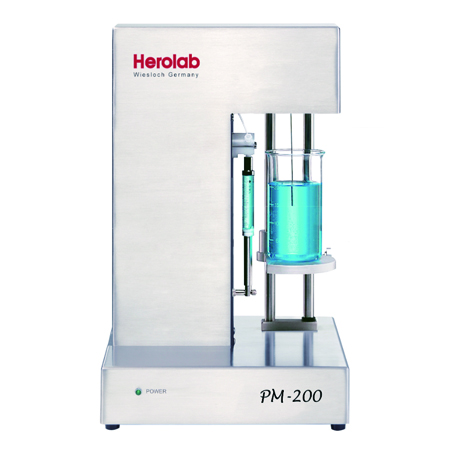
Herolab PM-200 – Liquid Particle Counter

Optical counting of insoluble particles in liquids using light obscuration, syringe-based sample feeding and PC-based analysis.

Sensor-dependent size ranges: 1–50 µm for pharmaceutical testing or 0.9–139 µm for general liquid analysis, both with latex calibration.

Price and lead time on request.

Discuss your configuration and request a quotation →

Herolab
Category: Brand:

Laboratory particle counting

The Herolab PM-200 counts insoluble particles in liquids and classifies them by optical size. A syringe feeds the sample through the measuring cell. Individual particles reduce the intensity of a light beam; the signals determine particle counts and size classes. A PC handles control and analysis.

Sensor and software selection

Two sensor and software combinations are available for pharmaceutical testing and general liquid analysis.

Feature Pharmaceutical testing General liquid analysis
Software Pharmaceutical analysis General liquid analysis
Particle size range with latex calibration 1–50 µm, linear 0.9–139 µm
Maximum particle concentration 100,000 particles/mL 120,000 particles/mL
Particle size channels Up to 8 fixed channels Up to 256 freely selectable channels
Sensor flow rate 20 mL/min 30 mL/min
Measuring cell dimensions 230 × 250 µm 300 × 300 µm

The ranges apply with latex calibration. The flow rates apply to the respective sensors. Selection depends on the sample medium, relevant particle sizes and test method.

Applications and samples

Applications include pharmaceutical solutions and contamination monitoring in water, beverages and process liquids. Residual contamination testing and further particle size analysis can be performed with suitable sample delivery and an application-specific configuration.

Colour, turbidity, high viscosity and gas bubbles can affect light obscuration measurement. Sample preparation, sample delivery and chemical compatibility must suit the sample.

Analysis and documentation

Analysis for pharmaceutical testing

The pharmaceutical analysis software supports measurement and analysis according to USP requirements and company-specific methods. Measurement series and diluted samples can be evaluated, with results available as tables or reports. The applicable test method and required documentation functions inform the choice of configuration.

Analysis for general liquid applications

The general liquid analysis software reports results cumulatively or by size class, based on particle count, volume or mass. Data can be exported for further processing in Microsoft Excel.

Configuration and scope of supply

The measurement system combines syringe-based sample delivery, a sensor, analysis electronics, software and a PC. The quotation specifies the supplied configuration, PC provision and accessories.

Instrument specification Value
Power supply 230 V AC
Dimensions (H × W × D) 405 × 260 × 260 mm
Weight 12 kg

Sample handling options

  • Magnetic stirrer
  • Automatic sample changer with a rotary tray for 20 sample bottles
  • Sampling from bags
  • Liquid feed with a funnel for residual contamination analysis

These options are available in addition to the selected measurement configuration and are included only when listed in the quotation.

Technical documents

Download product information

Herolab PM-200 · English · PDF · 2 pages · 268 KB

Request the specification of the proposed configuration and the calibration and qualification information needed for your assessment. Labsun helps you select the appropriate system and accessories.
Request technical advice →

Ordering information and supply configuration

The PM-200 is quoted for your measurement task. PM-200 is the model designation; the quotation specifies the selected configuration and binding order lines. The quotation also provides price and lead time.

Position Request / component Reference or selection To be defined in the quotation
1 PM-200 measurement system Sample delivery by syringe, sensor, analysis electronics, software and PC-based analysis Sensor and software configuration, PC provision, syringe and connections
2 Pharmaceutical configuration Pharmaceutical analysis; 1–50 µm, linear; up to 8 fixed channels Test method, software version and required documentation
3 General liquid analysis General liquid analysis; 0.9–139 µm; up to 256 freely selectable channels Sample medium, size classes and analysis requirements
4 Magnetic stirrer Sample handling option Version and suitability for the sample; list separately
5 Automatic sample changer Optional rotary tray for 20 sample bottles Container format and software integration; list separately
6 Sample delivery, syringes and spare parts Optional bag sampling or funnel feed; suitable syringes, connections and spare parts Volume, materials, version and quantity; model and serial number for repeat orders
7 Reference materials and calibration/test services Specify sensor and test protocol; measurement ranges refer to latex calibration Standards, certificates and required test scope
8 Installation, training and qualification Specify requirements and location PC setup, training and requested IQ/OQ documents or services

Use these entries to build your configuration. Select the required sensor and software combination and any options. Accessories and services form part of the supply when listed in the quotation.

Information for your enquiry

Start with your sample and measurement task. Where known, include:

  • Sample medium, viscosity, colour or gas formation.
  • Relevant particle sizes, expected particle concentration and available sample volume.
  • Test method, any pharmacopoeial requirements and sample throughput.
  • Software and documentation requirements, and any existing PC.
  • Destination country, quantity and requested accessories or services.

For repeat orders, please provide any known part number, instrument and sensor model, serial number, version and quantity. These details help identify the appropriate syringes, standards and spare parts.

Request a quotation →

Frequently asked questions about the PM-200

What does the PM-200 measure?

The PM-200 counts particles in liquids and assigns them to optical size classes. Light obscuration detects individual particles passing through the measurement cell. This does not establish suitability for airborne particle monitoring or chemical identification of the particles.

Which sensor and software combination suits my application?

The pharmaceutical testing configuration covers 1–50 µm, linear, with up to 8 fixed particle size channels. The general liquid analysis configuration covers 0.9–139 µm with up to 256 freely selectable particle size channels. These ranges refer to latex calibration. The sample medium and test method determine the appropriate selection.

Can I perform pharmacopoeial tests?

The pharmaceutical analysis software supports measurements according to USP requirements and company-specific methods. For your particular pharmacopoeial test, the method version, sensor, calibration, qualification and documentation requirements are assessed together.

Which liquids are suitable?

The platform is described for pharmaceutical solutions and contamination control of water, beverages and process liquids. Colour, turbidity, high viscosity, gas bubbles and chemical compatibility can limit suitability. Challenging samples require assessment before the configuration is selected.

How should samples be prepared?

Containers, sample feeding and preparation must suit the test protocol. Contamination and introduced air bubbles should be avoided. Mixing, degassing or dilution is used only when suitable for the sample and method; no universal sonication, filtration or dilution procedure is prescribed.

How much sample is required?

The total volume required is greater than the portion evaluated: initial feed, flushing, repeat measurements and the test protocol must be considered. Please specify the volume actually available. A universal minimum volume is not promised without confirmation of the proposed configuration.

What should I consider at high particle concentrations?

The maximum particle concentration is 100,000 particles/mL for the pharmaceutical configuration and 120,000 particles/mL for the general liquid analysis configuration. Higher concentrations can cause overlapping signals. Dilution must suit the method, with the calculation back to the original concentration included in the analysis.

What space, power supply and PC setup do I need?

The instrument measures 405 × 260 × 260 mm (H × W × D), weighs 12 kg and uses a 230 V AC supply. A suitable PC is required for control and analysis. The quotation specifies PC provision, interface, operating system, software version and licence scope; an existing PC is assessed for suitability.

Is the system automatically compliant with 21 CFR Part 11?

No. Where required, the functions of the offered software revision, including user permissions, audit trail, electronic signatures, backup and archiving, must be explicitly assessed. Operational controls, validation and SOPs form part of the overall system. A software name alone is not evidence of compliance.

Is an automatic sample changer included in the basic instrument?

An automatic sample changer with a rotary tray for 20 sample bottles is available as an option. It is included when listed in the quotation. Container format and software integration are matched to the selected configuration.

What is included in the supply?

The quotation lists sample delivery, sensor, measurement and analysis electronics, software licence, syringe and required connections. The PC, magnetic stirrer, 20-position sample changer, bag sampling, funnel feed and further accessories are listed according to your selection. Reference materials and services are agreed separately.

How are calibration and qualification agreed?

The stated particle size ranges refer to latex calibration. Required reference materials, count checks, certificates and intervals are selected according to the sensor and test method. You can request IQ/OQ documents or related services as a separate requirement.

How are the measurement cell and sample feeder cleaned?

Cleaning, flushing media, syringe replacement and maintenance follow the approved instructions for the supplied version and sample compatibility. No general approval for solvents, sonication or autoclaving should be inferred. Work on the sensor or electronics is limited to expressly authorised procedures.

What information does Labsun need for a quotation or repeat order?

For a quotation, useful details include the sample medium, relevant particle sizes, particle concentration, available volume, test method, throughput and software requirements. For repeat orders, add the instrument and sensor model, serial number and any known part number, version and quantity. PM-200 is the model designation; the quotation specifies the selected configuration and binding order line.

Please specify Herolab PM-200, your sample, measurement task and required configuration. For accessories or spare parts, add the serial number, any known part number and quantity.

Contact form

Enquiry / Quotation / Order

Phone:+49 (0)721 47080525
Fax:+49 (0)721 47080537
Email:info@lab-sun.de

Technical Customer Service

Phone:+49 (0) 721 47080579
Email:service@lab-sun.de